
Indian athletics finally got its golden moment at the Asian Games 2026. On 29 September, the women’s 4x400m relay quartet of Kiran Pahal, Poovamma Machettira, Prachi and Vithya Ramraj crossed the line first in Nagoya in 3 minutes 29.69 seconds, delivering India’s first athletics gold medal of the Games. The race also capped a remarkable championship for Ramraj, who left Japan with a gold, a silver and a bronze to her name.
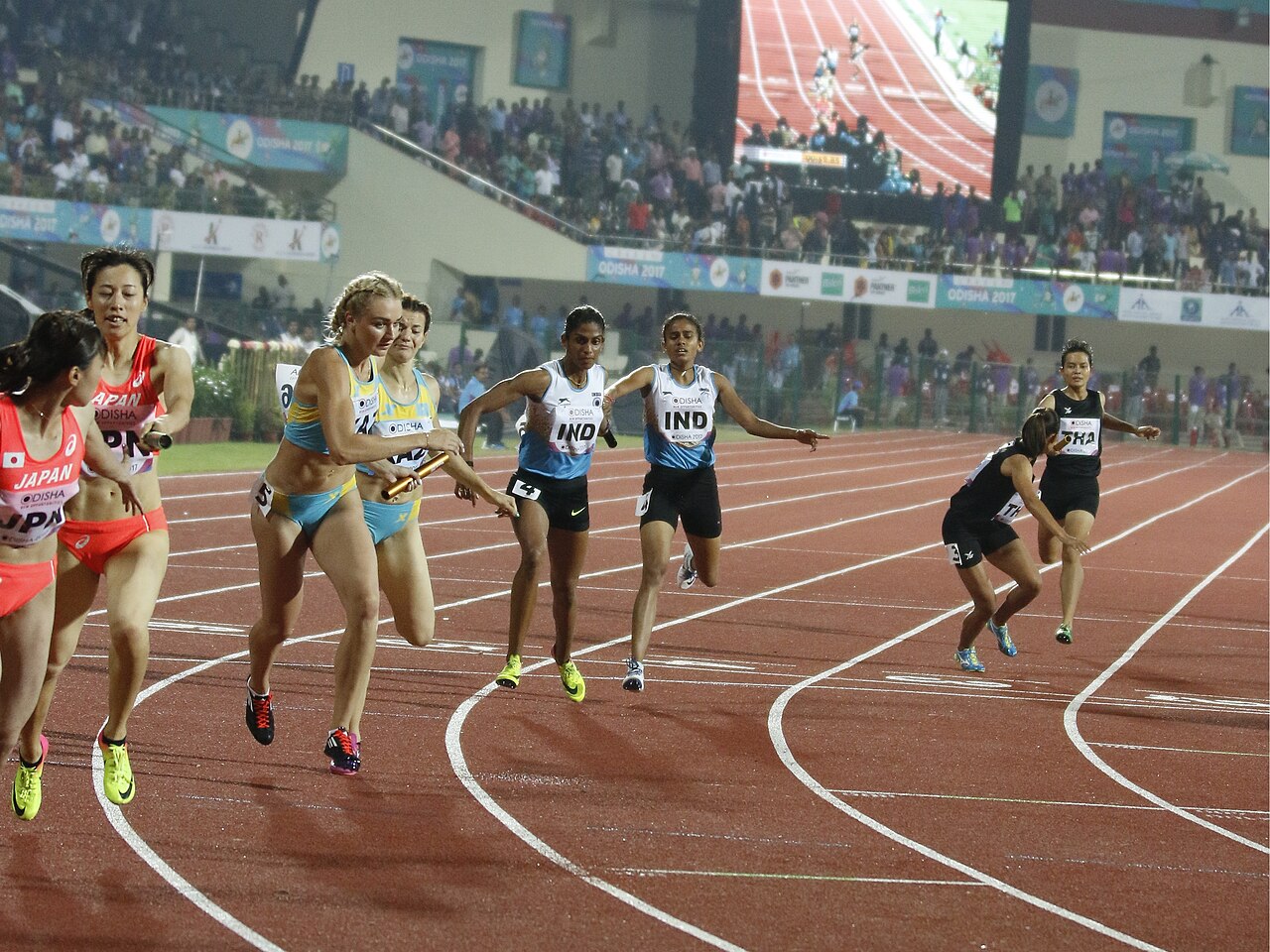
The race: India clock 3:29.69
India’s winning time of 3:29.69 was good enough to beat Bahrain, who took silver in 3:30.21, and China, who finished third in 3:31.02. The margin of roughly half a second over Bahrain shows how close the finish was in a discipline where baton changes and the final lap can swing the result in an instant. Reports of the event confirm the four runners and the time, and note that it was India’s first athletics gold of the 2026 Games.
The women’s 4x400m relay has long been a strong event for India in Asia, and the team’s depth in quarter-mile running shows in the result. Each athlete has to run a full lap at high intensity, so the team needs four strong runners rather than one or two stars. That balance seems to have been the secret to the victory in Nagoya.
Vithya Ramraj: gold, silver and bronze
The relay gold was only part of Vithya Ramraj’s week. According to a YourStory profile, she also won silver in the mixed 4x400m relay, where she ran the anchor leg and held off Vietnam to finish in 3:14.46, and bronze in the 400m hurdles in 54.75 seconds. A medal in each colour at a single Games is a rare feat, and it marks her out as one of the standout Indian athletes of the 2026 edition.
A national record in the 400m hurdles
The hurdles time deserves special attention. YourStory reports that her 54.75 broke the Indian national record of 55.42 seconds, set by PT Usha at the 1984 Los Angeles Olympics, a mark that had stood for 42 years. Ramraj had equalled the old record at the 2023 Asian Games in Hangzhou, where she also won bronze, so the new time was the culmination of years of near misses. The same report says Usha congratulated her, saying that records are meant to be broken, and that the Tamil Nadu Chief Minister, C. Joseph Vijay, announced a cash award of Rs 30 lakh.
From a truck driver’s daughter to Asian Games champion
The background of the champion is as compelling as the results. Ramraj is the daughter of a truck driver who supported three daughters, and she grew up in Meenakshipuram village in Madukkarai, Coimbatore. At times she trained without proper running shoes. She has a twin sister, Nithya, who is also an athlete, and the two lived in a sports hostel during their school years, which gave them access to training.
The path was not smooth. The profile mentions financial constraints, disruption caused by COVID-19 and health problems along the way. Both sisters later found central government jobs, which brought stability that helps in a sport where full-time training is expensive. Stories like this are a reminder that the medal table reflects not just talent but the systems, from school hostels to public-sector employment, that allow talent to survive.
Other Indian athletics medals on the day
The relay gold came on a busy day for Indian athletes in Nagoya. The mixed relay team of Gurindervir Singh, Animesh Kujur, Sneha Sathyanarayana and Harita Bhadra won bronze in a season-best 41.06, with China winning in 40.78 and Thailand taking silver in 40.87. Pooja Singh took bronze in the women’s high jump with a clearance of 1.84 metres, below her personal best.
In the men’s 5000m, Gulveer Singh won bronze in 13:32.75. It was his third podium finish of the Games after silver medals in the 1500m and 10,000m. The Deccan Chronicle noted that he became the second Indian man, and the fourth Indian overall, to win three track medals at a single Asian Games, joining Lavy Pinto in 1951, PT Usha in 1986 and KM Beenamol in 2002. In the pole vault, Dev Kumar Meena set a national record of 5.50 metres but finished seventh.
Analysis: why this relay gold matters
Athletics is the heart of the Olympic movement, and India has long been an underperformer on the track relative to the size of its population. A relay gold at the Asian Games does not change that overnight, but it does provide evidence that the country can win at the continental level in team track events. It also lifts the profile of quarter-mile running, where India has several strong athletes with shared training experience.
The broader day tells the same story. Medals in relays, jumps and distance running, plus national records in the hurdles and pole vault, suggest a squad that is getting better across several event groups rather than relying on one standout. If that trend continues, the next international calendar could bring further progress.
India’s overall Games performance
The athletics gold was one of 21 gold medals for India at the 2026 Games. The contingent finished fourth on the overall medal table with 85 medals, made up of 21 gold, 27 silver and 37 bronze. Prime Minister Narendra Modi was among those who congratulated the women’s relay team on their historic gold, according to a Morung Express report.
What’s next
For the relay team, the next goal is to build on the 3:29.69 and test themselves against the best in the world. For Ramraj, the question is whether she can keep lowering the 400m hurdles national record now that she has taken it below Usha’s long-standing mark. The domestic athletics season continues, with the Indian National Open Athletics Championships scheduled for 8 to 11 October, giving athletes a chance to show their form after the Games.
The numbers in the relay final
The three medallists were separated by under two seconds. India won in 3:29.69, Bahrain were second in 3:30.21 and China third in 3:31.02, so the gap between gold and bronze was only about 1.3 seconds across 1,600 metres of running. In a race where each of four athletes runs one lap, that margin can be eaten up by a single poor baton exchange or a slightly slower lap, which makes India’s clean execution all the more impressive.
What the medal tells us about Indian athletics
Relay medals are valuable because they reflect the strength of an entire event group, not just one star. A winning four-woman quartet implies several athletes capable of running quick quarter-mile splits, and that kind of depth is what a programme needs if it wants to challenge at bigger competitions. The additional medals from the mixed relay, the high jump and the distance events, together with the national records set in the hurdles and the pole vault, suggest that the Games were a productive meeting for Indian athletics overall. It will now be up to coaches and the federation to translate that momentum into a consistent run of results.
Conclusion
India’s women’s 4x400m relay gold was a landmark moment for the country’s athletes at the Asian Games 2026. The time of 3:29.69, the first athletics gold of the Games, and Vithya Ramraj’s remarkable haul of three medals, including a national-record hurdles bronze, make it a chapter worth remembering. It showed that Indian athletics can deliver on the continental stage and that stories of hard work from humble beginnings still have the power to inspire.