
India’s chess stars left the 46th Chess Olympiad in Samarkand with two medals, though the biggest talking point is how narrowly the men’s team missed something even better. The Indian open team finished with silver after tying with Germany on 18 points and winning the tie-break, while the women’s team secured bronze after a tense final-round draw against Georgia. Uzbekistan, playing at home, took the open gold and China won the women’s title.
How the open section finished
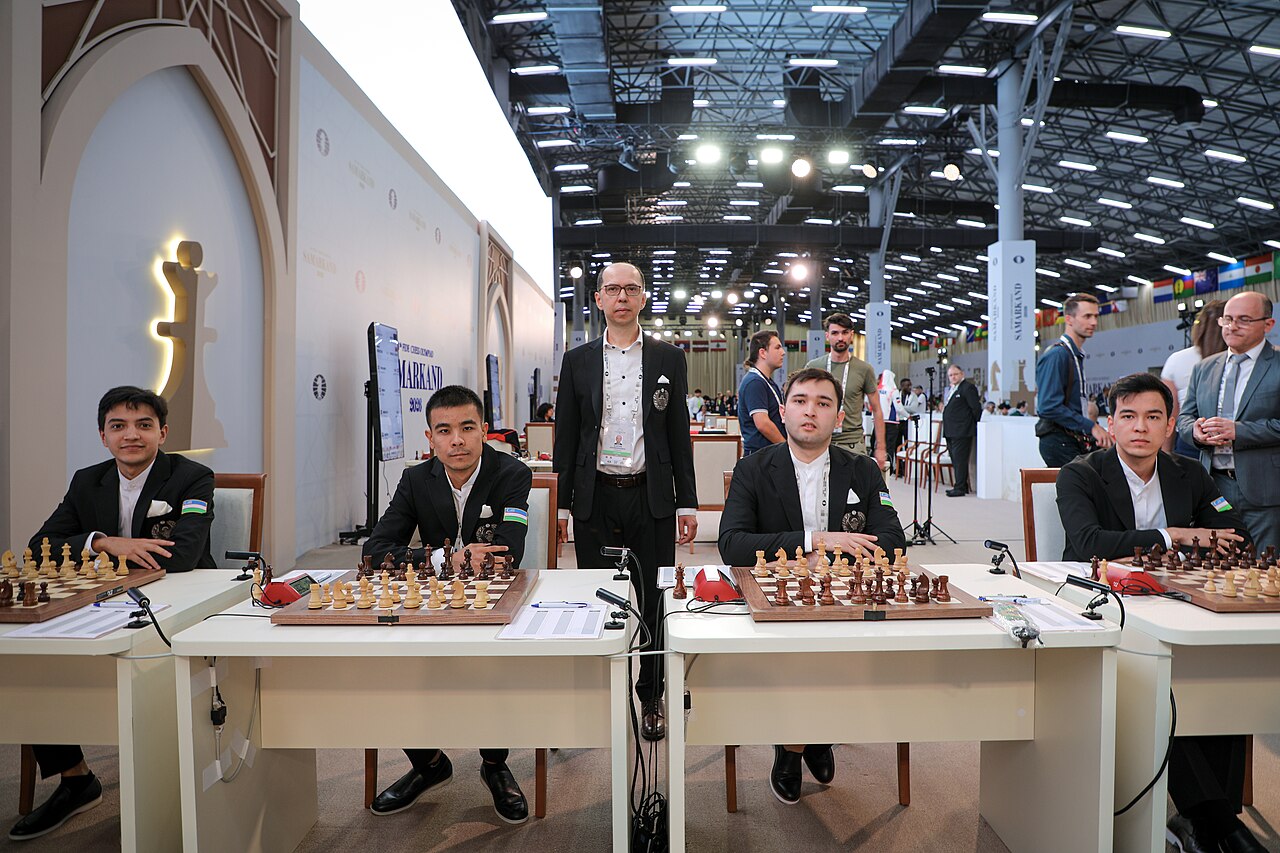
Uzbekistan won the open gold with 20 of a possible 22 match points. They won ten rounds and lost only once, to Germany, before closing the event with a 2.5-1.5 victory over Ukraine in the final round. The decisive point in that match came from Mukhiddin Madaminov, who beat Roman Dehtiarov. The home team finished two points clear of both India and Germany.
India and Germany both ended on 18 points, and it was India who took silver on the better tie-break score. Germany got bronze after beating the Netherlands 2.5-1.5 in the last round, with Matthias Bluebaum beating Jorden van Foreest. Hungary finished with 17 points. A tie-break is never a satisfying way to decide a medal, but it meant India’s campaign was rewarded with the higher of the two places.
India’s final-round draw with Hungary
India’s last match against Hungary ended 2-2. R. Praggnanandhaa drew with Richard Rapport, Arjun Erigaisi beat Peter Leko, Nihal Sarin drew with Benjamin Gledura, and D. Gukesh lost to Gleb Dudin. Arjun’s win was the swing result for the team, while Gukesh’s defeat was the one that stung most because of what it meant individually.
Praggnanandhaa finished the event with an individual bronze medal. Gukesh, according to the Deccan Chronicle’s report, narrowly missed out on an individual gold after that last-round loss. It is the sort of outcome that shows how small the margins are in an eleven-round team event: one result on one board can change a player’s medal colour.
Reading the tie-break in context
Finishing level on 18 points with Germany and then winning the tie-break is a reminder that Olympiad medals can turn on a single board result somewhere in the event. A draw instead of a loss or a win instead of a draw in any round could have shifted India either way. That makes the silver feel hard-earned rather than guaranteed, and it explains why the team will probably look back at the Uzbekistan margin of two points as the gap that mattered most.
The women’s section: China first, India third
In the women’s event, China took gold with 20 points after beating Vietnam 3-1 in the final round, finishing two points ahead of Kazakhstan. NewKerala’s report described it as China’s seventh women’s title. Kazakhstan took silver with 18 points after a 2-2 draw with Poland.
India earned bronze with 18 points after drawing 2-2 with Georgia, who ended on 16. Koneru Humpy beat Nana Dzagnidze, Divya Deshmukh lost to Bella Khotenashvili, Vantika Agrawal drew with Lela Javakhishvili and B. Savitha Shri drew with Meri Arabidze. Savitha Shri held a difficult position in her game to secure the half point, and that draw was what clinched third place. India finished ahead of the United States, Poland, Armenia and Mongolia on tie-breaks.
Individual medals for the women’s team
The women’s squad also did well in the individual medal table. B. Savitha Shri won the individual gold on her board with 9 points from 10 games. Divya Deshmukh claimed an individual silver, while Koneru Humpy and Vantika Agrawal each took bronze. Four individual medals for a team that finished third overall shows the depth of the squad, and it will be encouraging for a federation that wants to keep both sections competitive.
Analysis: what the results say about Indian chess
Two team medals and several individual medals at a single Olympiad is a strong return, and it confirms that India remains among the leading chess nations in both sections. In the open event, the team was within a tie-break of the same score as Germany and two points off the winners. In the women’s event, it was one of the three nations to finish on 18 or more.
There is also a clear generational story. Gukesh, Praggnanandhaa, Arjun Erigaisi and Nihal Sarin are all young enough to be central to the team for many years, and each of them was involved in decisive games in the final round. On the women’s side, a mix of established names such as Humpy and rising players such as Divya Deshmukh, Vantika Agrawal and Savitha Shri suggests that the pipeline is healthy.
Where the open team can improve
It would be unfair to be too critical of a silver medal, but the final round does offer a talking point. India drew 2-2 with Hungary, with a loss for Gukesh offsetting Arjun Erigaisi’s win, and the team ended two points behind Uzbekistan. Over an eleven-round event, small differences in form can decide whether a team finishes first or second, and those are details that players and support staff are likely to examine before the next cycle. That is analysis rather than reported fact, but it is a natural question after such a tight finish.
Uzbekistan’s home triumph
Credit is due to the winners. Uzbekistan’s 20 points from 22, with their only defeat coming against Germany, was a dominant performance on home soil. Beating Ukraine in the final round, with Madaminov scoring the decisive win, ended the event in the manner a host nation would have dreamed of. India finished second best to a team that was simply a little more consistent across the event.
What’s next for India’s chess teams
With the Olympiad finished, the players will return to their individual tournament calendars. For the national federation, the next objective is to turn these results into the kind of consistency that wins gold. Fans can expect the same group of names to feature prominently again, and the experience of Samarkand, particularly the tie-break finish in the open event, will be an important lesson for them.
Final standings at a glance
To summarise the podiums, the open section finished with Uzbekistan on 20 points, India on 18 taking silver on tie-break, and Germany on 18 taking bronze, with Hungary just behind on 17. In the women’s section, China won with 20 points, Kazakhstan took silver on 18, and India took bronze on 18, with Georgia on 16 after the final-round draw. Put side by side, the numbers show that both Indian teams were firmly in the medal race right to the final round, which is the best that any federation can ask from a long and demanding event.
Why Olympiad results matter beyond the medals
The Chess Olympiad is unusual because it is a team competition in a sport that is mostly individual. Players who normally compete only for themselves must think about match points, pairings and the needs of the team, and a draw that suits the team can be better than a risky attempt to win. That makes the event a useful test of temperament as well as skill. For Indian chess, strong team results also help to sustain public interest, sponsorship and the grassroots programmes that feed the next generation of players. Every medal in Samarkand therefore has value that extends beyond the scoreboard.
Conclusion
India’s Chess Olympiad 2026 will be remembered as a campaign of strong results with a small note of what might have been. Silver in the open section on the tie-break, bronze in the women’s section and a spread of individual medals show a healthy and competitive chess culture. The next step is converting those podium finishes into gold, and with the young talent on show in Samarkand, that looks achievable.